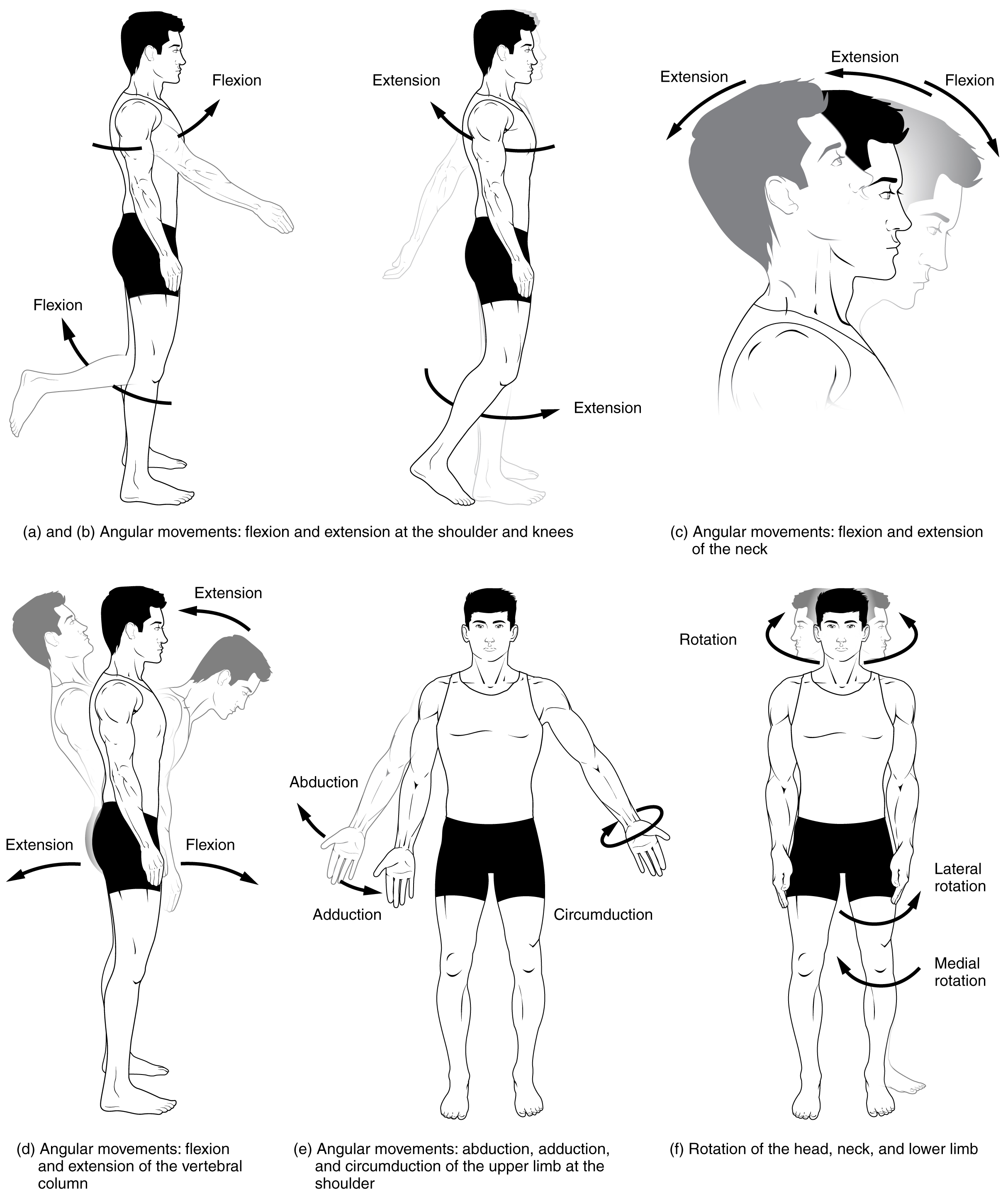
Anatomical Terms of Position & Movement
1. Define anatomical terms of position and movement
- Anatomical terms of position describe the relative location or orientation of a structure in relation to the body or other structures: dorsal (upper), ventral (lower), medial (towards midline), lateral (away from midline), proximal (near attachment), distal (far from attachment), anterior (front), posterior (back), superior (above), inferior (below).
- Anatomical terms of movement describe the type of motion a joint allows: flexion (bending), extension (straightening), abduction (movement away from midline), adduction (movement towards midline), rotation (twisting), circumduction (flexion + extension + rotation).
2. Apply the anatomical terms
- A muscle originating from the thoracic spine and inserting into the femur is proximal and distal respectively.
- A joint allowing flexion and extension is a hinge joint.
- A movement combining flexion, extension, and rotation is circumduction.
3. Demonstrate the movements
Flexion
- Elbow joint bends the arm towards the body.
- Biceps brachii contracts.
- Elbow straight (0°) → Forearm bends (90°).
Extension
- Elbow joint straightens the arm.
- Triceps brachii contracts.
- Elbow bent (90°) → Forearm straightens (0°).
Abduction
- Shoulder moves arm away from body.
- Deltoid contracts.
- Arm at side (0°) → Moves away (90°).
Adduction
- Shoulder moves arm towards body.
- Latissimus dorsi contracts.
- Arm away (90°) → Moves to side (0°).
Rotation
- Shoulder rotates arm.
- Rotator cuff contracts.
- Arm at side (0°) → Rotates (360°).
Circumduction
- Combination of flexion, extension, and rotation.
- Deltoid + rotator cuff contract.
- Arm at side (0°) → Moves in circular motion (360°).
Flowchart / Movement of the Arm